
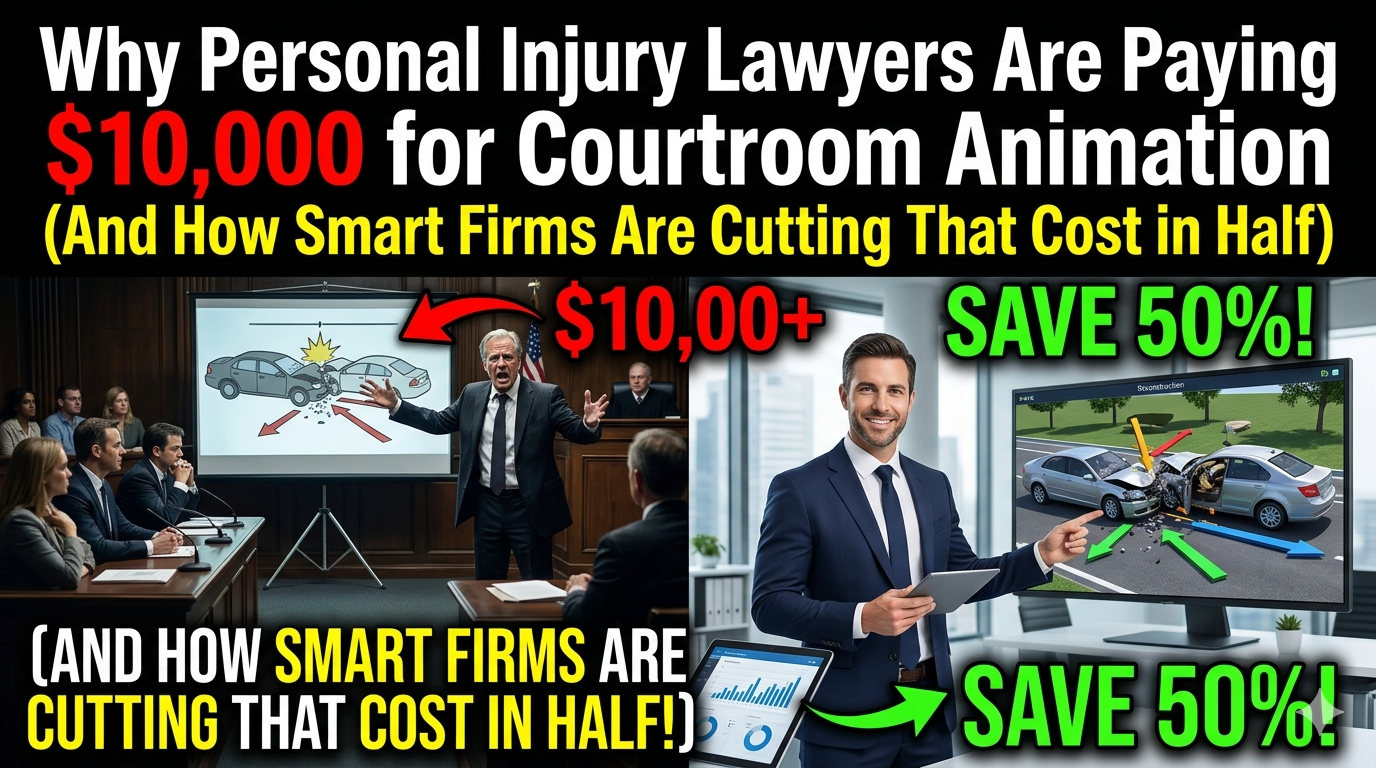
 A jury walks into a courtroom carrying biases, distractions, and the cognitive load of two days of testimony they barely understood. Your client’s life depends on whether twelve strangers can picture, in their minds, the exact moment a distracted truck driver crossed three lanes and broadsided a sedan at 62 miles per hour.
For decades, personal injury attorneys leaned on diagrams, photos, and expert witnesses with laser pointers. It worked — sometimes. But verdicts in the digital age are increasingly decided by what jurors see, not just what they hear. And the firms quietly pulling in the largest settlements have figured out something the rest of the industry is still catching up to: a single well-produced animation can do the work of three expert witnesses and shave days off jury deliberation.
The catch? That animation often costs $10,000 or more.
Let’s break down why, where the money actually goes, and how a new wave of creative studios is upending the trial-tech monopoly.
The Demonstrative Animation Boom
Industry observers report that demonstrative animations now appear in roughly 40% of high-stakes personal injury trials, up from less than 10% a decade ago. The shift is being driven by three forces:
- Juror expectations. People raised on Netflix documentaries and YouTube explainers expect motion, sound, and narrative. A static accident diagram on poster board feels archaic.
- Defense escalation. Insurance companies now routinely commission their own simulations. Plaintiffs’ attorneys who don’t match that visual firepower lose ground in the opening argument.
- Settlement leverage. A polished animation shown during mediation often pushes settlements 30-50% higher, even before trial. Defense counsel who watch a five-minute reconstruction get very motivated to negotiate.
The result: animation isn’t a luxury. For any case worth more than $250,000, it’s table stakes.
Where the $10K-$25K Actually Goes
Trial-tech firms — the traditional providers — typically bill in three layers:
- Engineering review: A licensed engineer reviews crash reconstruction reports, deposition transcripts, and physical evidence to ensure the animation is defensible under Daubert challenges. ($2,000-$4,000)
- 3D modeling and animation: Vehicles, environment, lighting, camera angles, and the actual motion sequencing. ($5,000-$15,000 depending on complexity)
- Expert testimony preparation: The engineer often becomes a witness, walking the jury through the video. ($3,000-$6,000 in deposition and trial fees)
For most plaintiff firms, especially solo and small practices working on contingency, that price tag is a problem. You don’t get reimbursed if you lose. And the cases that most need animation — the ones where liability is genuinely contested — are the same cases where you can’t predict the outcome.
The Quality Problem with DIY
Some firms try to cut costs with stock animation libraries or YouTube-tutorial-grade software. Don’t. A judge can — and will — exclude shoddy reconstructions under Federal Rule of Evidence 403. Worse, a poorly executed animation can backfire spectacularly in front of a jury that senses manipulation.
What separates a winning animation from an excluded one isn’t just budget. It’s craft: realistic vehicle dynamics, accurate sightline modeling, defensible camera placement (jurors should see what the witnesses claim they saw, from those exact positions), and visual restraint. The best animations understate. They show what happened cleanly and let the facts do the persuading.
The Creative Agency Alternative
Here’s the open secret: most of the actual production work — the modeling, animation, rendering, color, and sound — is the same work done by 2D and 3D animation studios serving entertainment, advertising, and product visualization clients.
Those studios charge $3,000-$6,000 for a comparable five-minute animation, because they’re not bundling in engineering credentials. The smart play for plaintiff firms is to separate the two costs:
- Hire your reconstruction engineer separately (you probably already have one)
- Hire a creative animation studio to execute the visualization based on the engineer’s data
- Have the engineer review and approve the final cut before submission
This split-vendor approach typically lands at $6,000-$8,000 total — saving roughly half the cost of a one-stop trial-tech firm, often with higher production values because creative studios live and die by visual quality. Studios already producing 2D and 3D work for ad agencies bring a polish to courtroom reels that engineering-led shops rarely match.
Beyond the Courtroom: The Marketing Multiplier
Animation budget shouldn’t end at trial. The same studios that produce courtroom reconstructions can build:
- Animated explainer videos for your website (“How a slip-and-fall case actually works”)
- Social-friendly motion graphics breaking down settlement amounts
- Onboarding animations for new clients explaining what to expect
- Recruiting videos for hiring associates and paralegals
Personal injury is a marketing-driven practice. Firms that produce consistent, branded video content — not just stock footage with a voiceover — capture an outsized share of organic search and referral traffic. A single animation series, repurposed across YouTube, Instagram Reels, and TikTok, can generate more qualified leads in a year than a billboard. The firms that build a content library this way also benefit when they hire: associates and paralegals research firms before applying, and the practice with a strong YouTube presence wins the talent war against equally compensating competitors who look invisible online.
There’s also a defensive angle. When opposing counsel or prospective clients Google your firm, what do they find? A handful of static directory listings, a Yelp page with three reviews, and a cookie-cutter About page? Or a library of case explainers, settlement walk-throughs, and testimonials presented in production-quality video? The second firm wins both reputation and recruitment by default, without spending another dollar on paid acquisition.
Building the Firm First
Production value matters, but it lands on top of foundations many lawyers overlook. Two things quietly shape whether your animation investment pays off:
A defensible firm name. If you’re launching a new practice or rebranding an existing one, the worst possible outcome is producing thousands of dollars of branded animation only to receive a cease-and-desist from a similarly named firm in another state. Before locking anything in, run your candidate names through a business name similarity checker to see how many existing firms operate under variants of your idea. The legal industry has more name conflicts than any other professional services category — common surnames plus “Law” or “Legal” plus geography creates massive overlap, and bar associations don’t catch it for you.
A search-discoverable website. Most law firm sites are technically broken in ways their owners don’t know about. They’re missing structured data, have orphaned pages from old practice areas, and never submit a current sitemap to Google. A practice that invests $8,000 in courtroom animation but skips the basic step of generating and submitting a proper XML sitemap is leaving organic case acquisition on the table. Sitemaps are the single most overlooked SEO fundamental in the legal vertical, and the firms that get them right see consistent indexing of new practice-area pages within days instead of months.
The Intake Problem Nobody Wants to Discuss
There’s one more cost-saver that rarely makes it into legal marketing conversations: filtering your inbound case inquiries.
Personal injury firms that run aggressive digital ad campaigns frequently report that 40-60% of “leads” coming through their contact forms are non-actionable — wrong jurisdiction, wrong injury type, no actual case, or outright fake submissions. A sizable chunk of the fakes are submitted using disposable email addresses by competitors trying to drain ad budgets, by frustrated former clients of other firms, or by automated form-spamming tools that hit every PI website in a region.
A simple step — running incoming form submissions through a disposable email detection layer — can cut intake-paralegal workload by hours per week. The technology is cheap, but most firms don’t deploy it because they don’t know it exists. Tools that maintain databases of known disposable email domains help intake staff focus on inquiries that actually deserve a callback, and the time savings often pay for the entire animation budget over the course of a year.
What to Do This Month
If you handle PI cases and don’t currently use animation:
- Pull your three highest-value pending cases. Identify which one has contested liability or complex causation.
- Get quotes from two trial-tech firms and two creative animation studios. Make them compete on price and reel quality.
- Ask each vendor for a sample reel that’s been admitted into evidence — not just a demo reel.
- Negotiate a fixed-price package, not hourly billing. Animation projects without scope caps spiral fast.
- Ensure your engineer-of-record reviews the final cut before any deposition reference.
The firms that figure this out in the next 18 months will widen the gap between themselves and competitors who are still printing 11×17 collision diagrams. Visual evidence is no longer a courtroom upgrade. It’s how modern juries decide cases — and the cost of producing it has never been lower for firms willing to look beyond the traditional vendor list.